
January 3, 2017


December 18, 2016
Business as usual at the White House
After the generalized commotion surrounding the US elections died down, the feeling of surprise lingered in the press, combined with predictions of imminent disaster. Against this alarmist tendency, I'm putting forward three obvious points:
- Although Trump's victory was unexpected (i.e. went against poll predictions), it follows a long-term pattern of Republican and Democratic presidents alternating every eight years. This has been the case since Eisenhower, with the exception of Reagan's first mandate.
- Speaking of Reagan, there are some striking similarities with Trump: both are (were) charismatic showmen, but not very intellectual and with a penchant for made-up stories. Time will tell how deep this resemblance goes.
- In contrast with his populist campaign speeches, Trump's post-election declarations and his cabinet choices signal that he will probably follow very closely the Republican platform: pro-big business, anti-abortion, pro-Israel, anti-environment control, for increased military spending, tax cuts for the rich, free trade and reductions in welfare programs. How many of these points were also on Clinton's agenda is left as an exercise for the reader.
December 1, 2016
CNRS positions - the 2017 campaign
The detail of the 2017 campaign for permanent research positions at the CNRS (Centre national de la recherche scientifique) has been published in the Journal Officiel (see links below) and the submission site is open. The submission deadline is
January 6th 2017. There are 211 open positions at the CR2 level (4 less than in 2016), 75 CR1 (2 less), 256 DR2 (+3) and 2 DR1 (+2). The total number has been stable over the last five years, as shown in the graph below:

November 21, 2016
Internship proposals
I have two internship openings at the M2 level for 2017. Contact me for more information.

Optical and structural properties of polymer - nanoparticles composites
Supervisors: Emmanuel Beaudoin and Doru Constantin
 Viral nanocages assembled around gold nanoparticles
Supervisors: Doru Constantin and Guillaume Tresset

Optical and structural properties of polymer - nanoparticles composites
Supervisors: Emmanuel Beaudoin and Doru Constantin

Supervisors: Doru Constantin and Guillaume Tresset
November 20, 2016
The Ewald sphere
The Ewald sphere is a widely used concept, but one that is quite difficult to grasp in the beginning (at least it was for me, as well as for some of my colleagues.) It can be seen as a way of converting vectors between the "real" space, in which the experiment is performed, and "reciprocal" space.
November 18, 2016
Solution Self-Assembly of Plasmonic Janus Nanoparticles
Our paper appeared in Soft Matter.
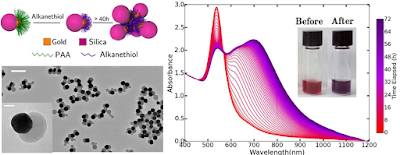

Congratulations to Nicolò Castro for his first paper as first author!
October 21, 2016
October 10, 2016
Curvature of a planar curve
I have done this calculation several times over the years, so I might as well write it down in detail, in case it may be of use to someone else.

We are interested in the curvature \(C = 1/R\) of a planar curve \(y=f(x)\) at a given point A, where \(R\) is the curvature radius at that particular point, defined with respect to the curvature center \(O\) (intersection of the normals raised to the curve in A and its infinitesimal neighbor B.)
The angle subtending AB is: \(\displaystyle \mathrm{d}\alpha = \mathrm{d}s/R \Rightarrow C = \frac{\mathrm{d}\alpha}{\mathrm{d}s}\)
The length of the curve element AB is: \(\displaystyle \mathrm{d}s = \sqrt{\mathrm{d}x^2 + \mathrm{d}y^2} \Rightarrow \frac{\mathrm{d}s}{\mathrm{d}x } = \sqrt{1+ f'(x)^2}\)
The derivative of \(f\) is directly related to the angle \(\alpha\): \(\displaystyle f'(x) = \frac{\mathrm{d}y}{\mathrm{d}x} = \tan \alpha \Rightarrow \alpha = \arctan \frac{\mathrm{d}y}{\mathrm{d}x} = \arctan [f'(x)] \Rightarrow \frac{\mathrm{d}\alpha}{\mathrm{d}x} = \frac{1}{1+f'(x)^2} f''(x)\)
Putting together the three relations above yields:
\[C = \frac{\mathrm{d}\alpha}{\mathrm{d}s} = \frac{f''(x)}{\left [ 1 + f'(x)^2\right ]^{3/2}}\]
August 12, 2016
Identification of a major intermediate along the self-assembly pathway of an icosahedral viral capsid
Our paper appeared in Soft Matter!


The modelling and fitting of the SAXS data required lengthy analysis and intensive calculations. In particular, we used the analytical model for scattering from spherical patches that I had published last year.
August 2, 2016
Titles
I learned today that the title of the fourth book in Proust's Search of Lost Time (Sodome et Gomorrhe) was translated in English as Cities of the Plain, same as Cormac McCarthy's novel, and that the expression comes from King James Version of the Bible. Looks like most novels in the English language borrow their title from the KJV (Yeats's poems are a close second, though).
I also found out that the title to Wittgenstein's Tractatus Logico-Philosophicus was inspired by Spinoza's Tractatus Theologico-Politicus. Also, 60 years before Spinoza Robert Fludd wrote his Tractatus Theologo-Philosophicus, which is closer in title (although probably not in content).
Subscribe to:
Posts (Atom)